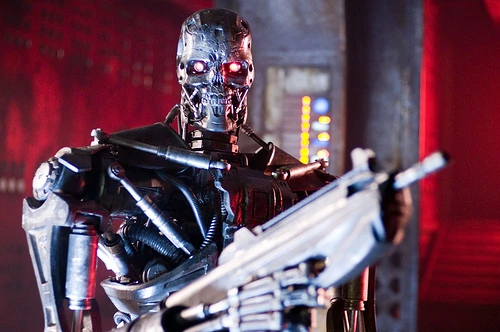
The notion of "self-aware" computers has been around focused on by academics since the 1950's. Computers and programming was still in its infancy then but the new possibilities led their minds to ponder where does it end?
In today's world it still seems a stretch to go from my crash prone computer to a self aware HAL or Skynet. But follow Moore's Law over time and computing speed continues to increase while cost continues to drop.
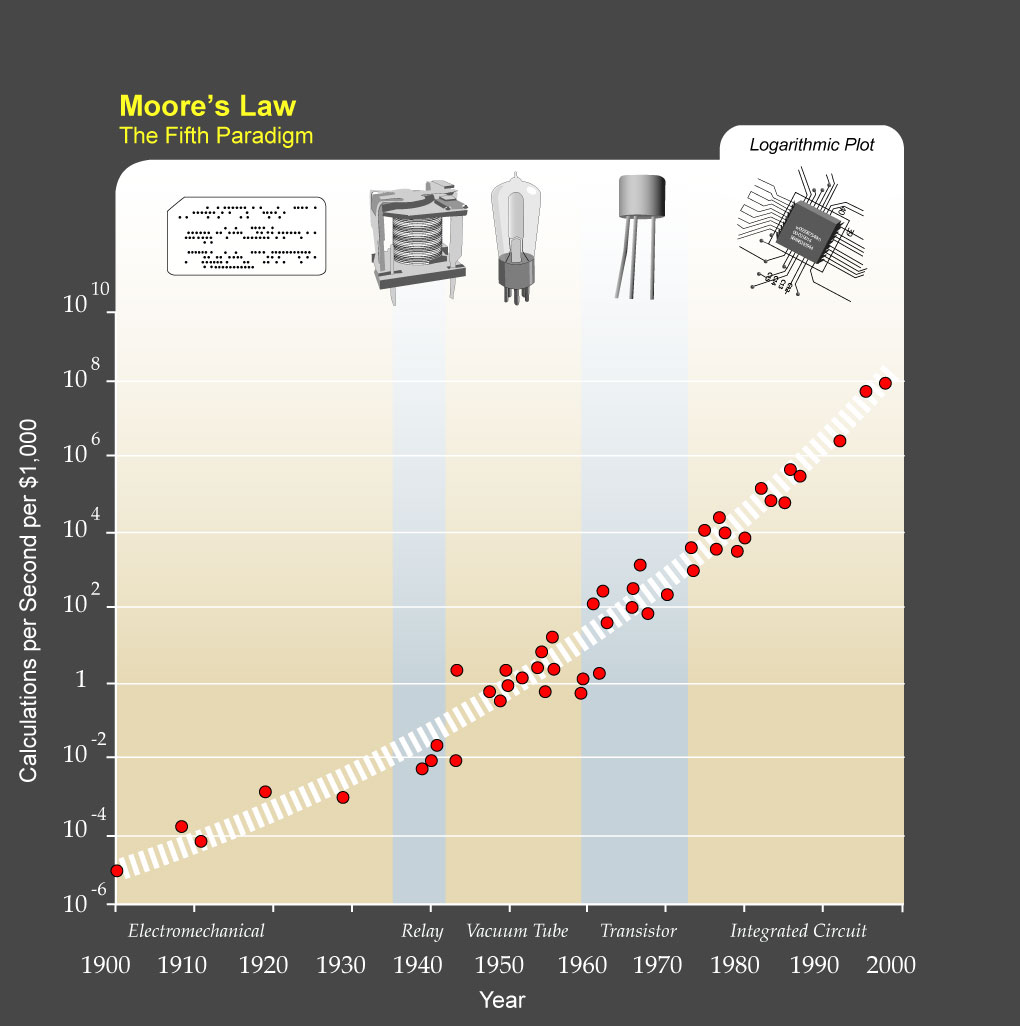
As the trend-line goes, in another few decades computers will catch up with the computing ability of the human mind. If computing capacity is not just relegated to novelties like playing chess or Jeopardy, and given more latitude to solve problems we see the jump analogous to a few amino acids making the jump to self replicating life, but in an exponentially growing time span not geologic.
The chart just graphs a single device making calculations, not a linked internet. Global computing capacity continues to grow exponentially, becoming more and more interconnected. Web-bots are being used for basically data mining now, but what happens when the data starts to be put together. A botnet can be used to access millions of computers, the information and capacity is out there or will be out there as time goes on.
An artificial intelligence program could go rogue and it probably only takes one time. Scientists are already working on this and what to do in possible contingencies. Building an off switch, but how do you do that with out it knowing. How do you do anything without it knowing or just having built in redundancies for survival. It becomes that the technological singularity is more evolutionary biology than it is computer science.
NPR did a piece on this topic a while back, showing how some of the brightest minds in silicon valley are working on dealing with issues that may arise with the rise of the machines.
As a post script:
If not looked as something to fear, but as the next step in evolution. Thinking in geologic time frames, since the formation of the earth man has walked it very little. The earth has not been habitable to man through most of its existence. The universe is far more friendly to silicon based "lifeforms" than carbon based lifeforms. To think that humans may become the intelligent designers of future distant civilizations may not be far off. Mankind has dealt with die offs in mass proportion in the past and will sure do so in the future. We haven't mastered pandemic flu, meteoric impact, or even climate change let alone the possibility of anthropogenic climate change. We may be out lasted by what we have helped create.

No comments:
Post a Comment